The Trust Gap in AI-Generated Code
Key Takeaways
- As the development lifecycle collapses, the central question is whether verification inside the AI loop can stay reliable enough, or whether it needs to happen outside it.
- Until verification keeps pace with generation, enterprises will keep paying more for AI coding without seeing the productivity gains they expected.
- Enterprises and VCs are funding generation first: roughly 95% of AI dev tools venture capital has gone to coding assistants and agents.1
- The winners will become part of how teams ship as engineering roles evolve from writing code to overseeing it.
THE CORE THESIS
The bottleneck in software is no longer writing code. It’s trusting what gets shipped.
The demo is easy to love: give an agent a task, watch it build, ask for a few changes, and suddenly there's a working product. If you've spent any time with these tools, you understand why the money is pouring in. As a result, software suddenly feels more abundant. The distance between “someone should build that” and something you can actually click has gotten remarkably short.
But then comes the less cinematic part. Does it work with the rest of the system? Does it handle the customer who does something nobody anticipated? Can you explain why it made that decision? And who is putting their name on the release?
That is the gap we're interested in at Collide. As producing software gets cheaper, the ability to decide what can safely ship becomes more valuable. We think some of the next important infrastructure companies will be built around that decision.
Our favorite starting point is specific: tools that validate critical workflows before release, learn from what happens in production, and become part of how a team decides it is ready to ship. A company doesn't have to write all the code to earn that position. It has to become very good at telling the customer whether the code does what they need it to do.
Better models expand what teams can attempt, making confidence in larger, more consequential changes more valuable even as the code itself improves.
THE NEW DEVELOPMENT LIFECYCLE
The lifecycle has collapsed. Verification hasn’t kept up.
Software development has always involved a loop: decide what to build, write it, test it, review it, ship it, and find out what you missed. Agile development and continuous delivery were compressing that loop long before coding agents arrived. AI is pushing the compression much further.
An agent can now work on an implementation, generate tests, and revise both in the same session. It’s useful, but it also creates a particular kind of false confidence: the code and the tests can agree with each other while both being wrong about what the business wanted.
Imagine asking an agent to change subscription cancellations. It writes code that ends access immediately, then writes tests confirming that access ends immediately. Everything passes. Unfortunately, the actual policy lets customers keep access until the end of the billing period. The software faithfully implements the wrong answer. Running the same loop again may give you a cleaner implementation of the same mistake.
What helps is another source of truth: the cancellation policy, an agreed customer journey, or a test written against the intended outcome.
This isn't an argument for putting every change back through a committee. The opportunity is instead to make verification keep up with generation.
The research is starting to describe that tradeoff. DORA's analysis of its 2025 findings links higher AI adoption with both greater delivery throughput and greater instability.2 It also describes time saved creating code being reallocated to auditing and verification. Those are associations, not a verdict that AI makes software worse. They are a reason to look at the whole delivery system.
The distinction that matters is what the check knows and what authority it has. A second agent can repeat the first agent’s mistake; a check inside the development workflow can still bring in independent evidence. The goal is to keep the speed while making sure the software is tested against something beyond its own assumptions.
THE PROBLEM IN DETAIL
A taxonomy of AI-generated technical debt
AI, of course, didn’t invent technical debt. Humans have been shipping questionable code with impressive confidence for decades. What changes is how quickly mistakes can accumulate, how much context any one person holds, and how easily the same assumption can spread through the implementation and its checks.
It helps to look at where the debt enters the system. A misunderstood requirement starts during generation. A rushed approval lets it through review. An untested configuration exposes it at deployment. The production incident may be the last link in a much longer chain.
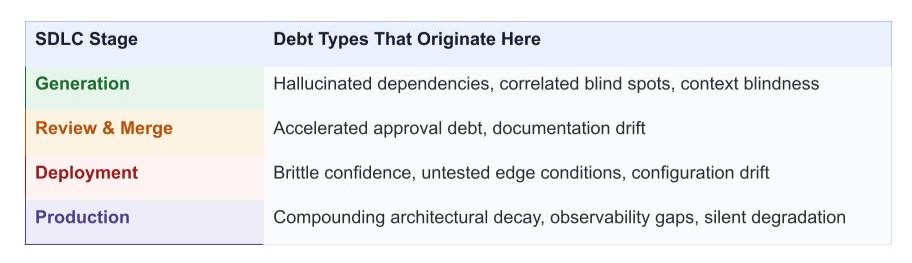
THE FOUR TYPES OF DEBT IN DETAIL
We can group AI-generated debt into roughly four types by where in the lifecycle it originates.
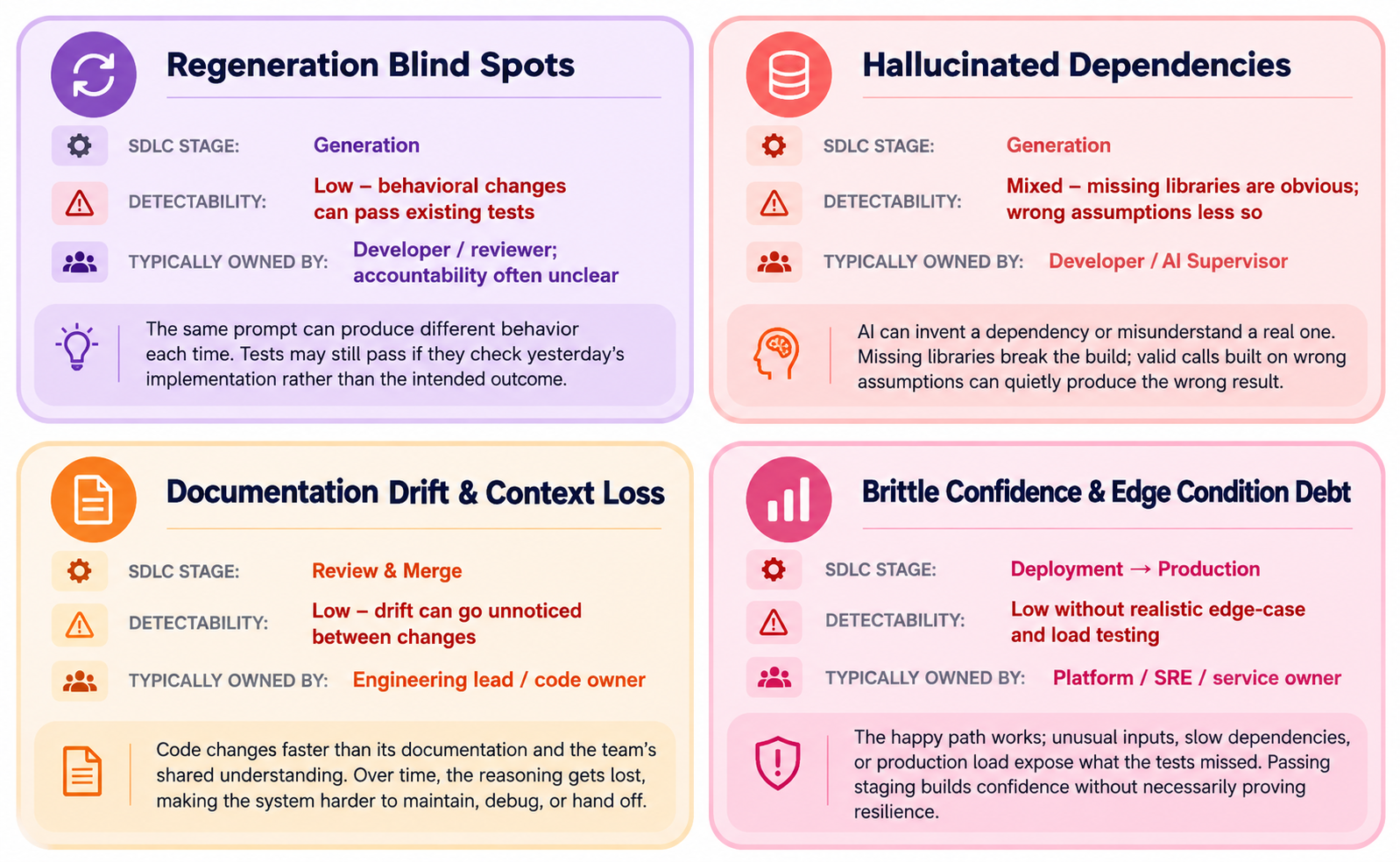
These patterns overlap and aren’t unique to AI-generated code. Each exposes a different gap between what existing checks confirm and what the software actually needs to do.
Individually, none of these looks catastrophic initially. Each passes the check in front of it.
The danger is downstream. A small, plausible failure at generation propagates untraced until it surfaces as a production incident, by which point the cause is buried. That gap between where the debt originates and where it finally shows up is why we think a separate check matters.
Why existing code review tooling misses some of this
A linter can catch a bad pattern without knowing the cancellation policy. A passing unit test can confirm the implementation without testing the right requirement. Monitoring can show that something broke after customers have already felt it. Each tool answers a useful question, but the questions don’t always add up to “is this safe to ship?”
The result: AI coding tools don’t just add to the existing debt burden - they change its texture in ways that are harder to see, harder to measure, and faster to compound.
That leaves room for better validation, not a clean slate. Existing testing, security, and monitoring tools already catch many of these failures. The opportunity is to connect more of the evidence, cover important workflows, and reduce the work required to keep those checks useful.
WHY NOW
The generation layer has outrun everything else
The timing comes down to one sequence: cheaper generation, lagging confidence, real costs, and rising autonomy, each driving the next.
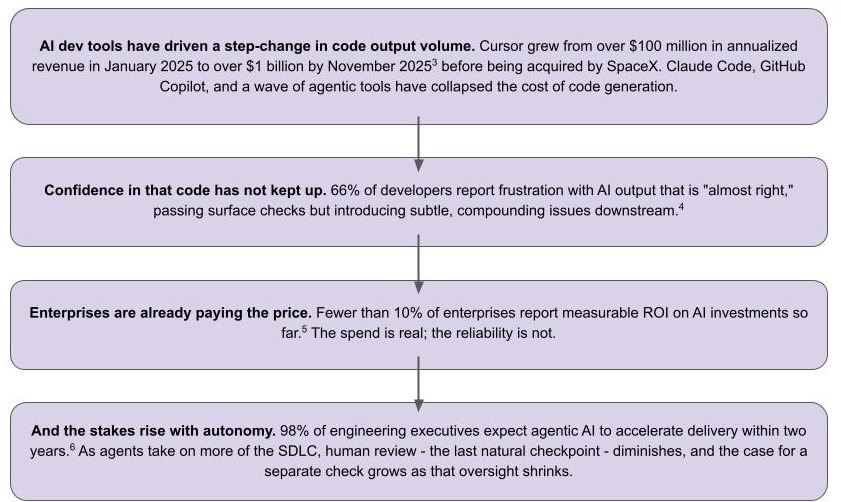
None of these trends is slowing, and each makes the next more costly.
WHERE THE MONEY IS GOING
Customers and investors are both funding generation first
Two numbers make the asymmetry in our core thesis concrete: what enterprises are spending on AI coding tools, and where venture capital has gone within developer tooling.

Enterprise spend on AI coding tools grew from $550 million in 2024 to $4 billion in 2025, roughly 7x in a single year, making coding the largest category of departmental AI spend.7 Enterprises are funding code generation at scale.
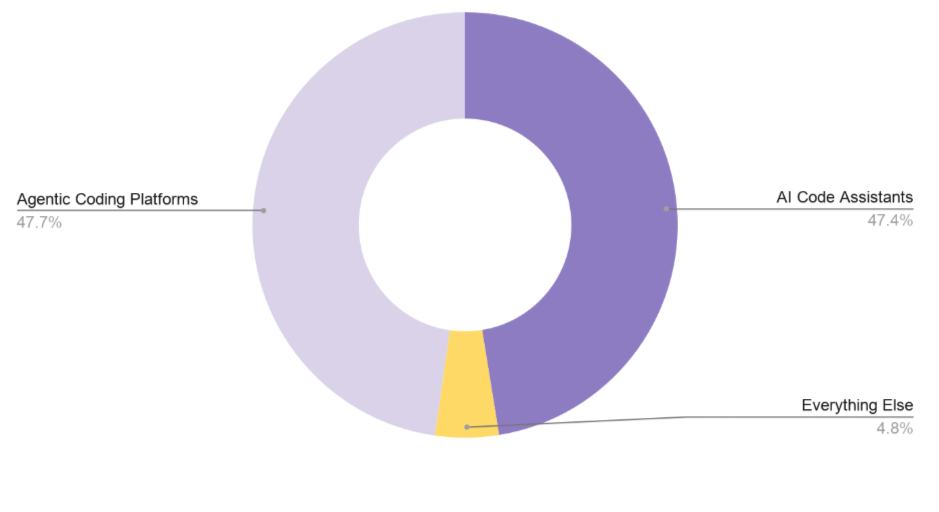
Between August 2025 and July 2026, roughly 95% of disclosed venture capital in AI dev tools went to code assistants and agentic coding platforms, the generation-native end of the spectrum mapped later in this paper, while all other related tools, including standalone review, testing, and security, drew roughly 5% combined.1
Together, these numbers give a sense of where customer and VC money has gone so far - enterprises and investors have poured capital into producing code faster, and comparatively little into confirming it works. That gap is the opportunity the rest of this paper maps.
THE INVESTMENT OPPORTUNITY
Near-term: point solutions closing specific gaps
We like tools that start with a pain the customer already knows. A permissions mistake, a broken checkout, or a billing regression is a better starting point than promising to govern every line of software in the enterprise.
- Pre-deployment validation layers: catching AI-specific failure patterns before merge
- Simulation and sandbox environments: testing behavior at scale before production exposure
- QA tooling designed for AI output: moving beyond test suites written in the same loop as the code, toward independent checks on whether it does what was intended
- Observability and monitoring: connecting production failures to the changes that caused them, and feeding those lessons into better checks before release
Our strongest interest is in validating important workflows before release and connecting those checks to production feedback. The product has a clear job, and the customer can tell whether it is doing that job well.
Long-term: platforms that own outcomes across the lifecycle
The interesting progression is from a helpful check, to a check people rely on, to a required part of releasing important changes. That is when a tool starts to look like infrastructure.
From there, the platform can expand from one critical workflow to more applications, teams, and release decisions. Our commercial bet is that greater responsibility earns a larger share of the customer’s spend. The company can become an assurance platform across the lifecycle while working with whichever coding agents the customer prefers.
We also wouldn’t require a promise of bug-free software. Commitments around coverage, turnaround, or response are more credible. Selling an outcome is attractive when the customer can measure it and the company can deliver it at a healthy margin. Otherwise, the guarantee is just a service obligation wearing a software multiple.
MARKET MAP
The clearest way to see where trust infrastructure is being built is to plot it on an axis of how separate the quality check is from the code generation that produced it:
Market Map of Startups by Degree of Integration
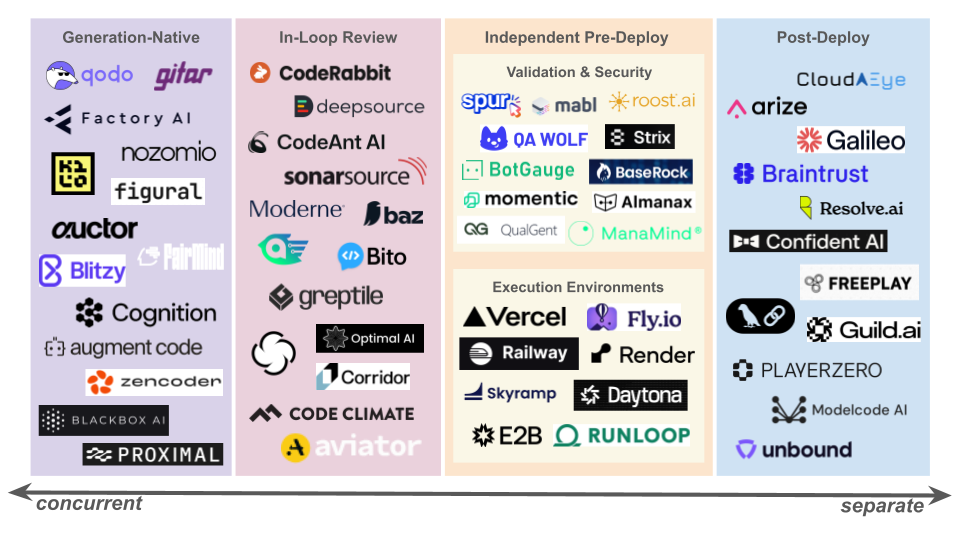
This map plots the ecosystem along a single spectrum, from concurrent to separate. On the left sit tools where validation happens inside the generation loop; on the right, tools that function as an independent checkpoint the code has to clear.
The distinction helps us ask whether a check brings fresh evidence or repeats the generator’s assumptions. We see opportunity in greater independence, though position alone doesn’t guarantee it. The spectrum has four zones, with pre-deployment split into two groups.
- Generation-Native - Tools that generate code and check it in the same loop, from established platforms to newer entrants. Built-in validation is useful, but code and tests can share the same blind spots. These platforms set the baseline that independent tools must improve on.
- In-Loop Review - Standalone products that review changes within the development workflow, often acting as quality or security gates. They share repository context with the generator but can bring different rules and evidence. Their value depends on what they catch beyond the built-in checks.
- Independent Pre-Deploy - A particularly interesting opportunity: checks and environments that help establish confidence before code ships. We split this zone into two distinct roles.
- Validation & Security - Tools that test behavior or security before release, from agentic and end-to-end testing to vulnerability discovery and penetration testing.
- Execution Environments - Sandboxes and cloud environments where generated code can run in isolation. They provide a controlled place to test; isolation alone doesn’t prove correctness.
- Post-Deploy - Tools that observe live behavior, detect drift, and support incident response. Production provides evidence that development checks may miss, but failures can already be affecting customers. The strongest feedback loops turn those lessons into better checks before the next release.
HOW THIS BECOMES A CATEGORY, NOT A FEATURE
What we believe, and how confident we are
The open question is whether enterprises will buy this as a separate product or get enough from the coding and observability platforms they already use. Below are the three beliefs behind our thesis, ranked by our confidence in each.
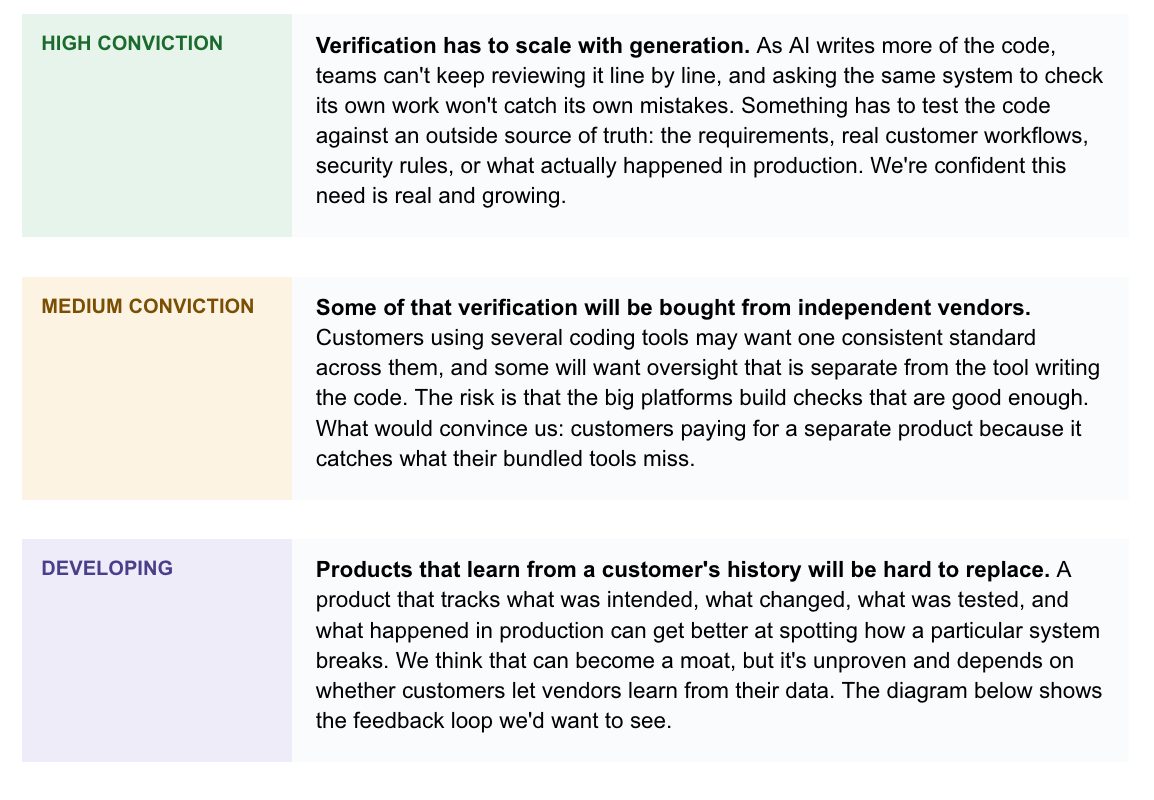
We shouldn’t wave at “proprietary data” and assume the hard part is done.
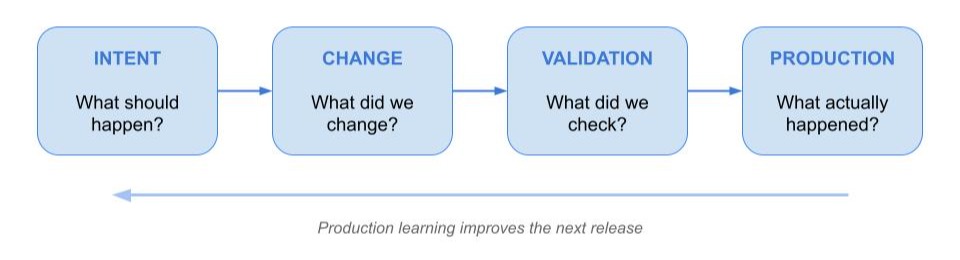
The incumbents deserve credit here. GitHub already brings agents, review, and governance into the same environment;8 LaunchDarkly supports monitored rollouts and automatic rollback.9 A startup needs an answer to a straightforward question: with those existing tools switched on, what do you catch, prevent, or make easier that the customer still can’t do well?
WHO USES THESE TOOLS
The buyer question itself is a signal
As agents take on more development work, the responsibilities around generating, supervising, and approving code may shift. This map explores who uses these tools and who might pay for them, through three roles that can overlap within the same team.
Market Map by Evolving End User Profiles
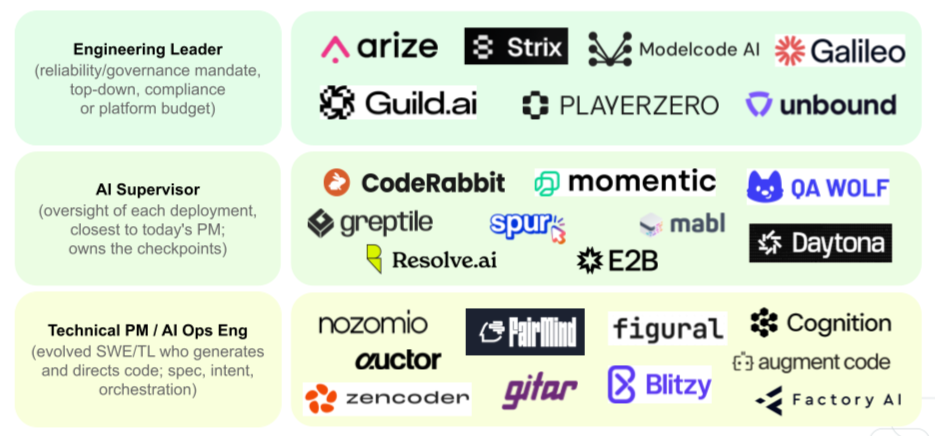
The three rows map emerging responsibilities:
- The engineering leader owns the consequences. They need to know whether the team can deliver more without losing control of reliability, cost, or security. Auditability and governance matter, but so does a product that makes releases easier rather than adding another approval queue. This is the most straightforward budget owner.
- The AI Supervisor owns the checkpoints. This could be an engineering, QA, platform, or technical product lead today: someone accountable for whether a deployment is ready. As agents take on more work, that person needs better evidence and a wider span of oversight. There may be a new title here eventually; the responsibility already exists.
- The Technical PM / AI Ops Engineer directs the work. Think of the engineer or tech lead translating intent into instructions, coordinating agents, and checking the result. Their immediate need is less debugging, test upkeep, and manual review. They are a natural bottom-up entry point, even if someone else ultimately signs the contract.
The rows also suggest a buying motion: leadership purchases top-down, engineers adopt bottom-up, and oversight tools sit between them - with room to grow into broader budgets. The buying trigger often tells us more than the title: a review queue that won’t clear, recurring regressions, or pressure to ship more without another layer of reviewers.
Investment implication
We look for products that start with the practitioner and grow by earning responsibility for critical releases. A move into a reliability or security budget can be a useful signal, but a different budget label doesn't make revenue sticky. What makes it sticky is becoming part of how the customer ships.
KEY OPEN QUESTIONS
- Who becomes the end user? Our base case starts with today’s engineers and technical leaders. New oversight roles may emerge as autonomy grows, but the thesis doesn’t need developer headcount to collapse. We would follow who uses the evidence, who owns the decision, and who funds it.
- Where do incumbents leave room? Which workflows remain poorly served with the customer’s existing tools enabled - and is the improvement large enough to justify a separate purchase?
- How fast does autonomous deployment arrive? Adoption will vary with the cost of failure and the quality of the controls. We prefer products useful in human-led teams now, with more responsibility to earn as customers delegate more. A distant autonomy forecast is a weak substitute for a current reason to buy.
- Will customers procure this separately? Some will prefer one platform; others will pay for better coverage, independence, or specialized expertise. Repeat use, expansion, and a clear budget owner will tell us more than a category name. A product has to justify another vendor.
- What if the models get much better? Good - we would rather back a company that benefits from AI working than one that needs AI to keep failing. Better models will remove some mistakes and enable more ambitious work. The durable question is whether an important workflow still behaves as intended. Tools that only patch a passing model weakness have a shorter runway.
WHAT WE’RE LOOKING FOR
What would make us lean in
While we have conviction in the category, individual deals can look very different in diligence. Below are some of the signals we are looking for.
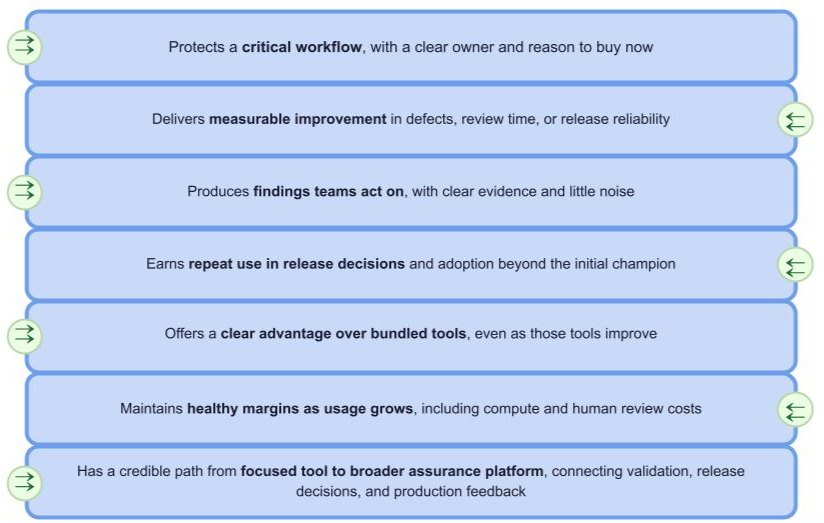
The first wave made it dramatically easier to produce software. We think the next opportunity is helping organizations put more of that software to work with confidence. For us, it comes down to two questions: what evidence does the product provide that the customer doesn’t already have, and what important decision does that evidence let them make?
If the answer is another opinion about the code, the business may stay a feature. If the customer can safely release something they otherwise couldn’t, the product has a chance to become infrastructure. That is the trust gap we want to back.
SOURCES
- New Market Pitch, AI Code Assistants: What’s Funding Like Now?
- DORA, Balancing AI Tensions: Moving from AI Adoption to Effective SDLC Use
- Cursor, Past, Present, and Future
- Stack Overflow, 2025 Developer Survey: AI
- Forbes, The Hidden Costs That Are Undermining Enterprise AI ROI
- MIT Technology Review, Redefining the Future of Software Engineering
- Menlo Ventures, 2025: The State of Generative AI in the Enterprise
- GitHub, Introducing Agent HQ: Any Agent, Any Way You Work
- LaunchDarkly, Managing Guarded Rollouts
written by