The Disappearing First Rung
When the steam engine first arrived, it did more than transform production. It transformed people. Entirely new industries emerged almost overnight, and with them came a new system for developing talent: the modern apprenticeship. Factories created structured pathways that taught unskilled workers how to operate machinery, follow procedures, and eventually master a trade. Every major technological shift has done something similar. New tools create new kinds of work, and new work requires new ladders into the workforce.
Now, as artificial intelligence ushers in the next great transformation, we are facing a very different reality. The ladders have not appeared. AI is quietly swallowing the tasks that once defined entry-level jobs. The foundational work that taught people how to think, how to communicate, how to become professionals is disappearing. The question is no longer whether jobs will change. They already have. The real question is what happens when the bottom rung disappears.
AI is uniquely good at performing junior work. While the Industrial Revolution automated physical labor and the internet streamlined information retrieval, AI is taking over the tasks that once trained analysts, assistants, coordinators, and junior developers. GitHub Copilot generates nearly half of a developer’s code. Klarna’s AI resolves millions of customer service tickets, performing the workload of hundreds of people. IBM is pausing hiring across entire back office categories in anticipation that automation will take over. These were not filler tasks. They were the crucible in which early-career professionals learned judgment, accuracy, communication, and discipline. Without them, how does someone build competence?
A small early career survey we conducted reflects this shift. Few respondents found early opportunities through campus recruiting or structured programs. Most broke in through online job boards or cold outreach, which suggests that the smooth on-ramp once provided by institutions has eroded. The next generation is not being ushered into the workforce. They are fighting their way in.
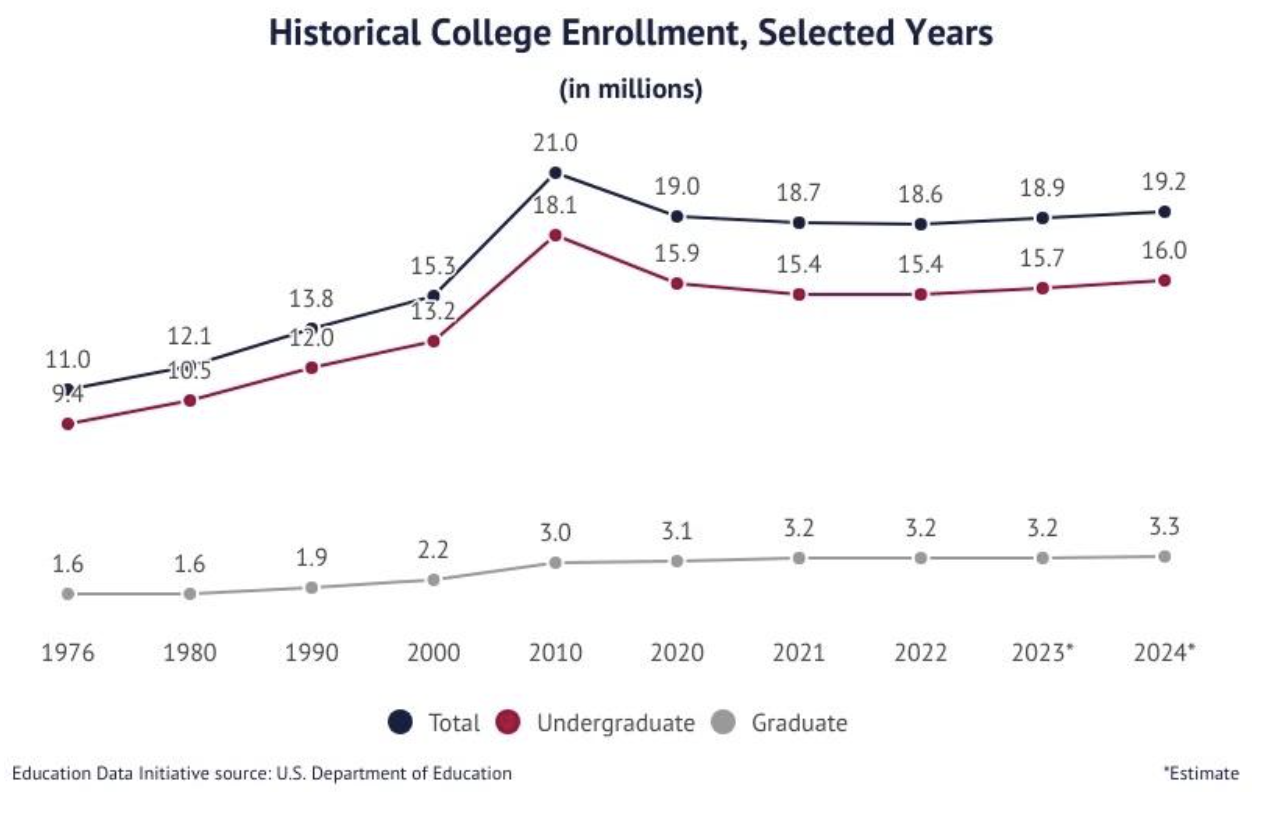
The traditional pipeline through higher education is also weakening. College enrollment in the United States has been declining for more than a decade, falling from its peak of around 18 million undergraduates in 2010 to roughly 15.5 million in 2025. Community college enrollment has fallen nearly 40 percent in that same time frame. Students are increasingly skeptical that a degree guarantees a stable beginning, especially when employers still ask for experience that can no longer be earned organically because the foundational work no longer exists.
This shrinking of the pipeline would be concerning in any era. In an era where AI is removing the early career learning curve, it becomes existential. In our survey, nearly half of respondents reported that their current or recent job offered little or no structured training, which aligns with the broader pattern of employers seeking plug-and-play talent rather than investing in development.
Before AI, entry-level workers absorbed knowledge by doing. They shadowed colleagues, repeated low-stakes tasks until the muscle memory formed, and learned through the small mistakes that eventually shaped intuition. But AI automates the repetition that once built skill. If junior analysts no longer draft the first version of reports, or junior product managers no longer write the first PRD, or junior developers no longer write boilerplate code, the apprenticeship by doing model collapses. Teams remain productive, sometimes more productive, but only because AI has effectively become the unseen junior employee. The problem is that this benefit is short-term. Years later, organizations realize their talent pipeline has hollowed out. They have senior leaders, but no pathway for creating the next generation of them.
This is the real risk of the AI era. Not job loss, but experience loss. Not automation, but the erosion of the systems that taught people how to grow.
Yet there is also opportunity. Just as the factory created the apprenticeship and the internet created the analyst program, the AI-enabled workplace will create its own version of early career development. It will not look like the old model, which was physical and hierarchical. It will be hybrid, modular, project-based, and powered by tools that allow people to learn while contributing meaningful work.
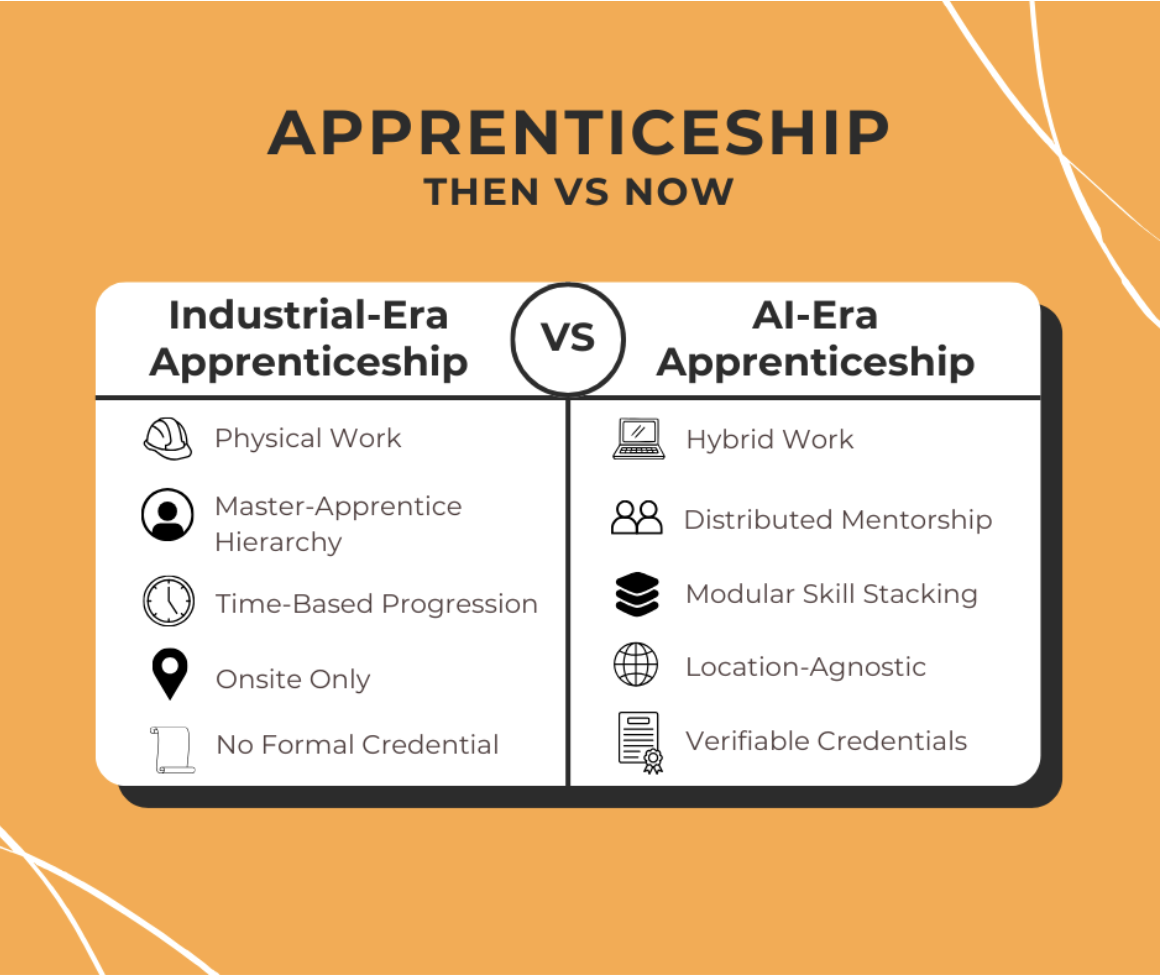
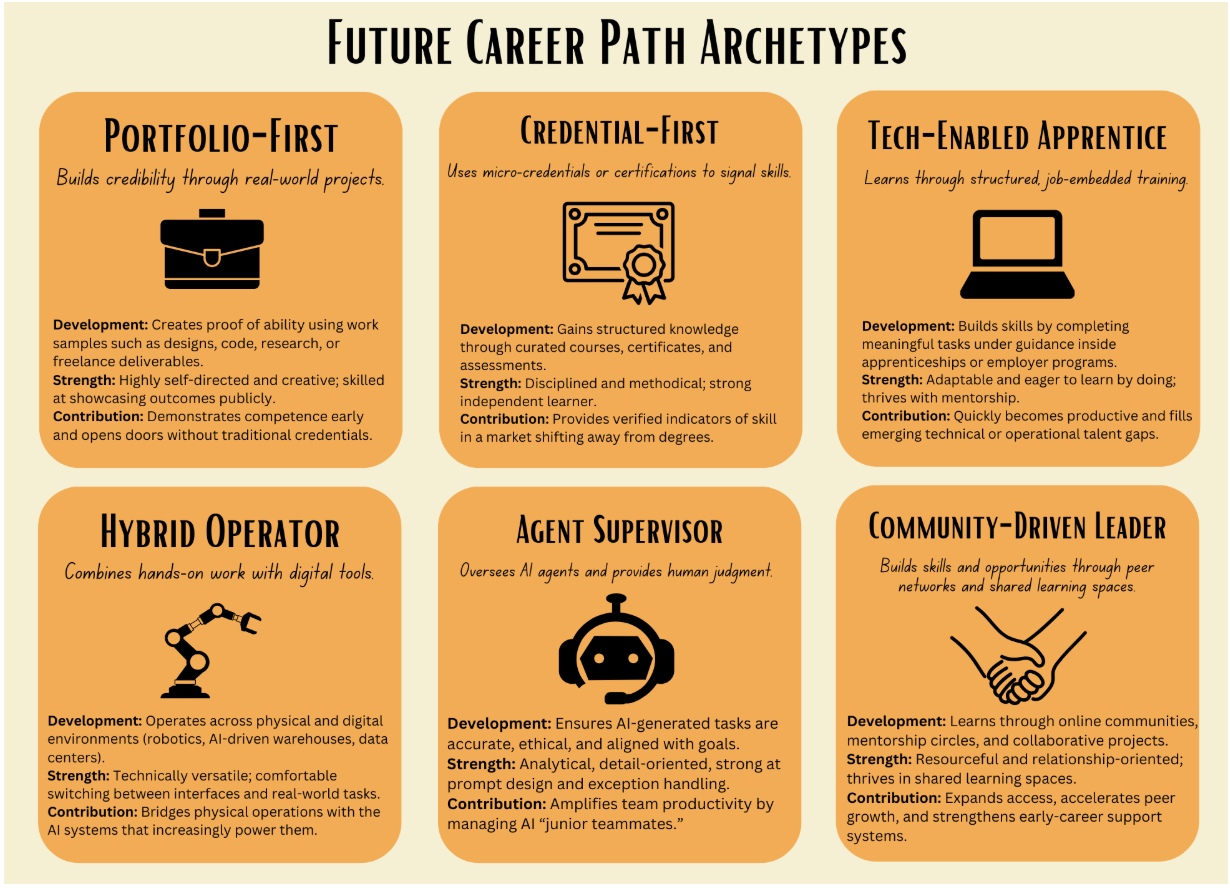
A modern apprenticeship might involve managing AI agents, handling exceptions instead of routine tasks, building a portfolio of real work rather than relying on a resume, earning stackable micro credentials, or participating in cross-company training networks. It might blend human and AI mentorship. It might emphasize proof of capability rather than time spent. Our survey responses point to this transition. Many early-career workers are already relying on online courses, side projects, or freelance work to build skills because traditional jobs are not providing the training they once did. They are learning in public, stitching together their own ladders because the old ones no longer exist.
They are becoming portfolio-first workers, credential-first workers, hybrid operators, and supervisors of AI agents. These new archetypes are not fringe. They are becoming mainstream because the system around them is shifting. But they also highlight a gap. These paths were not intentionally built. They emerged out of necessity.
When asked what is most missing from the early career ecosystem, survey respondents gave answers that echoed across generations. Solid pipelines. Transparency. Opportunities to be trained and grow. Mentorship. A clear path upward. In other words, a ladder, or at least a blueprint for one.
If past technological revolutions created new ways for people to enter the workforce, what will the AI revolution create? For all the uncertainty, one thing is clear. We need new systems for learning, new pathways for gaining experience, and new apprenticeship models that prepare people for an era shaped by agents and automation. This is not about preserving the past. It is about preserving upward mobility, the core promise that work has always offered.
The Industrial Revolution created apprentices. The Internet Age created analysts. The AI Revolution will create something new. But only if we choose to build it.
written by