

AI in Skilled Trades and Field Services
Overview Summary for Investors and Operators
- AI in blue-collar goes venture-scale when it is embedded into the work itself - within the general steps diagnostics, estimation, permitting, inspection, and verification - rather than bolted onto administrative tooling.1
- Within all blue collar work, skilled trades and field services are the most ripe for new venture-scale opportunities. The field is uniquely underdigitized, even within blue collar work, and business models make sense for software to give a massive productivity boost unseen in recent history.
- Category winners will be outcome sellers – aka service execution and not just platform management. Winners will charge for fewer truck rolls, faster approvals, higher first-time-fix, verified progress, or reduced downtime - and use software as the delivery mechanism.2
- “Why now” is thanks to convergence of model capability, cost curves, and labor constraints. Inference has gotten dramatically cheaper, multimodal AI is production-grade, construction and home services remain under-digitized, and labor scarcity is increasingly binding.3
Section I: Why Now is the Time to Invest
Introduction: Where software meets the work
In the wake of the white collar AI revolution, we’ve arrived at a moment where blue-collar work is finally having its moment.
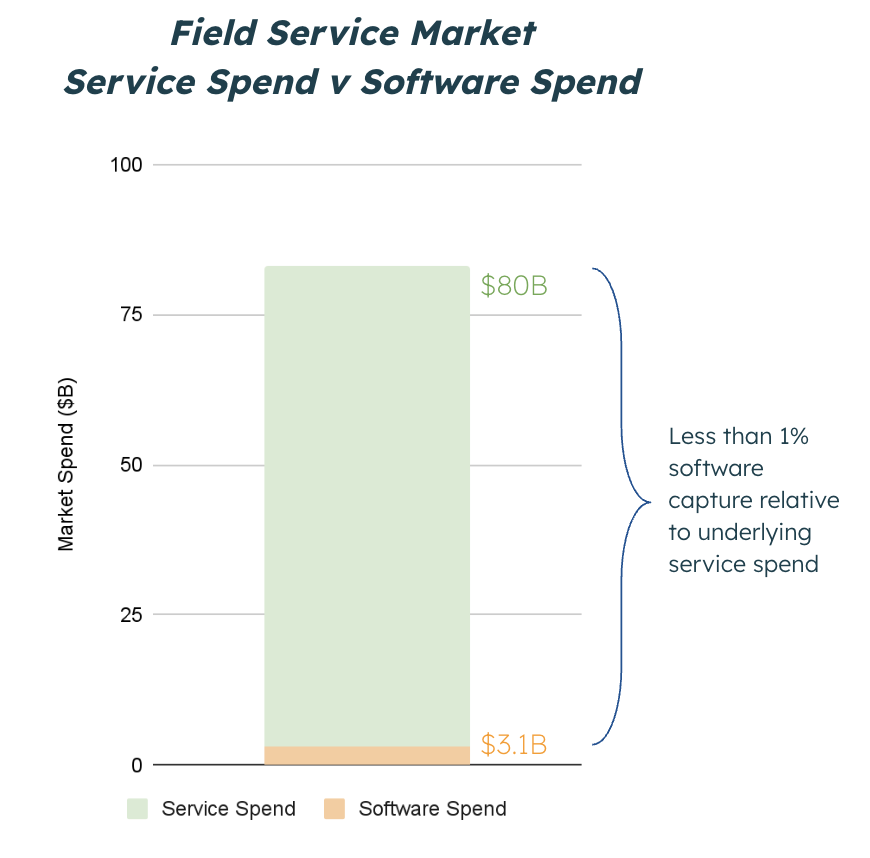
What the PE rollup kings of the world have come to realize is that blue-collar industries represent some of the largest and least digitized sectors of the economy for opportunity, yet decades of software investment have barely moved the needle on how work actually gets done. And it’s about time early-stage venture caught up with what later-stage investors have already recognized.
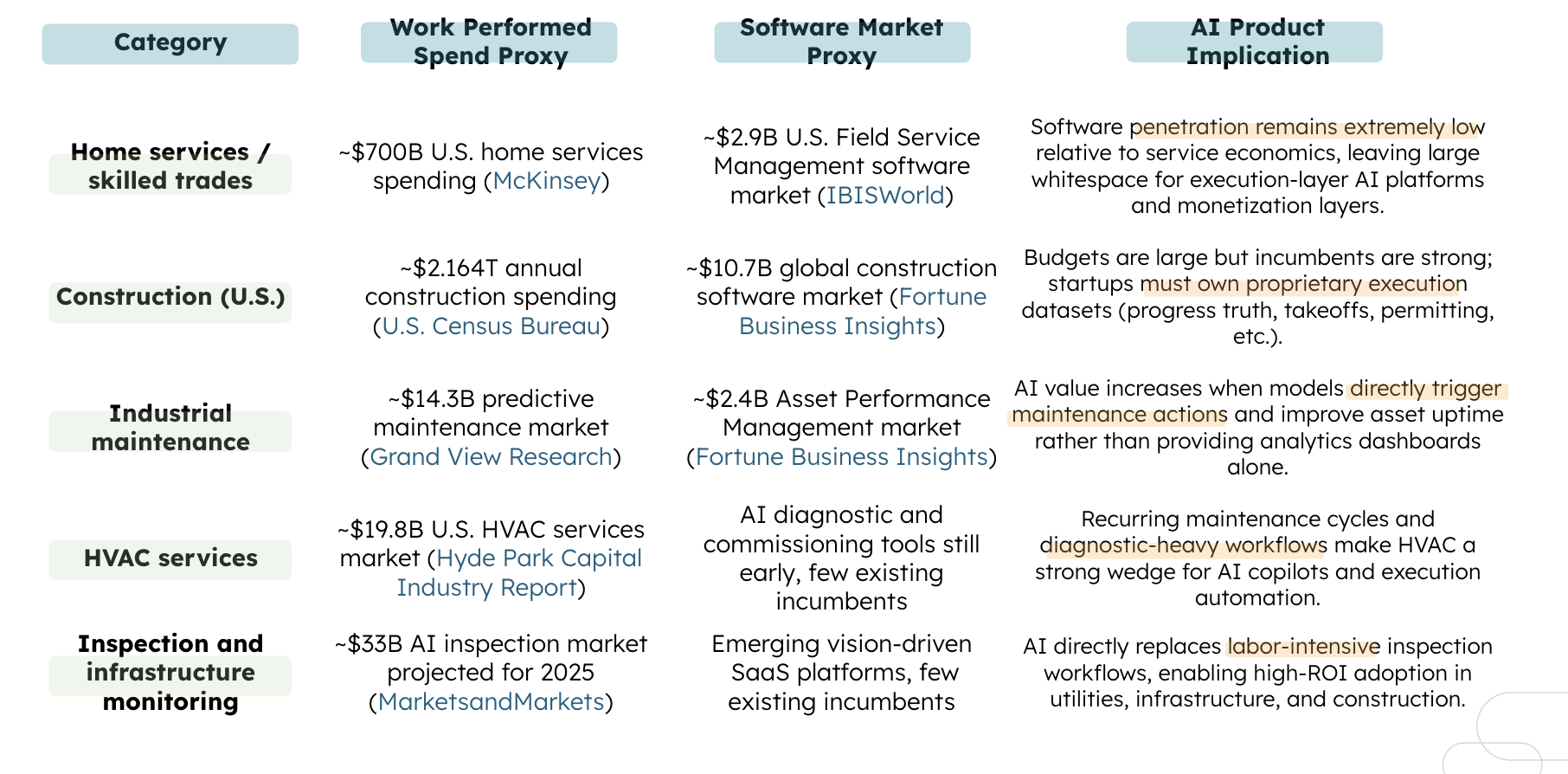
In U.S. home services alone, annual spend is roughly $700B, while the field service management software market is only ~$2.9B.4 Even allowing for definitional mismatch, software captures well under 1% of total value.
Similar gaps exist across construction, maintenance, and industrial services. The issue is not awareness or willingness to adopt - it is that most software has been built around the work, not inside it.
This thesis began as a broad exploration of AI in “blue-collar work,” but some categories within blue collar work are already quite well capitalized. The category is too expansive, and not all segments are equally investable. Instead, the focus shifts to where two conditions consistently hold:
- the work is highly technical and decision-heavy, with clear points where better decisions directly translate into revenue, cost, or risk
- there is meaningful whitespace, either due to limited existing startup density or a lack of products that fully leverage emerging AI capabilities
This lens surfaces four categories with the strongest underlying dynamics:
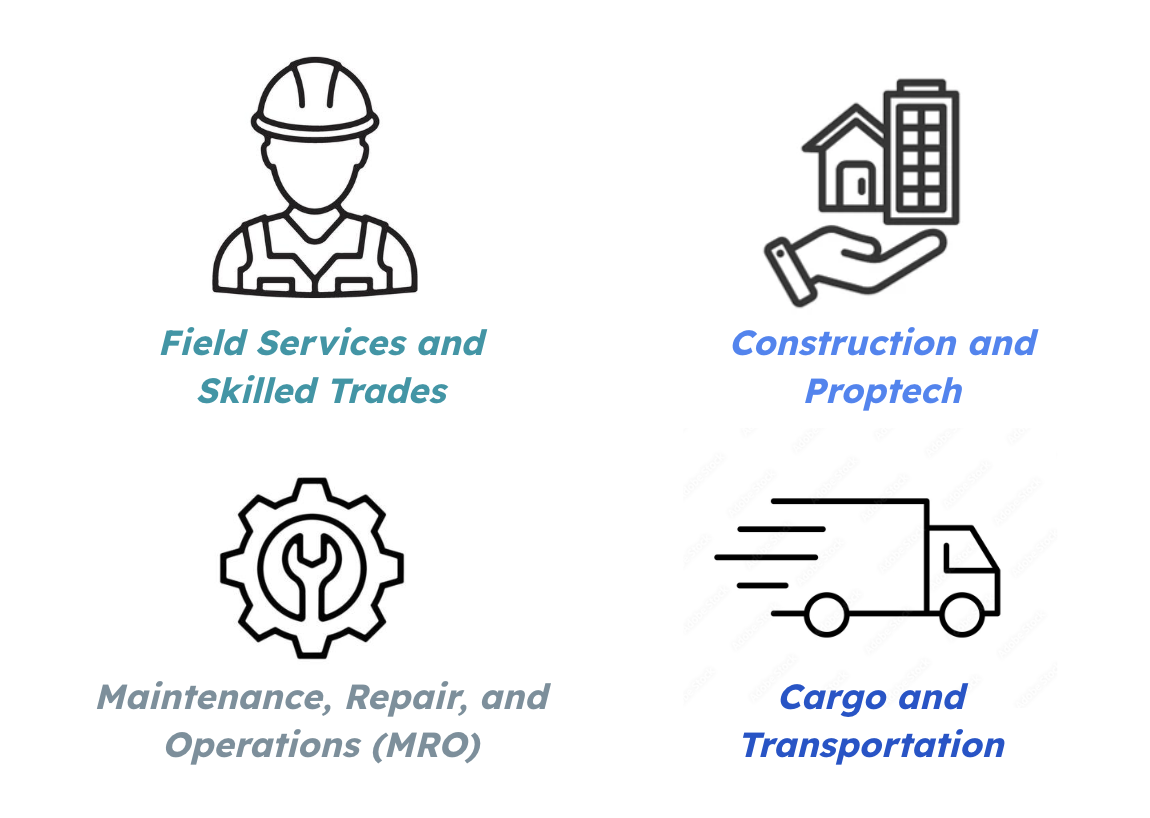
Across each of these markets, operators are constantly translating messy, real-world inputs (e.g. photos, site conditions, equipment signals, and regulatory requirements) that software has only slowly become integrated into.
But at best, most software still sits adjacent to decision-making moments. It organizes work, but rarely determines it.
But early examples of this shift are already emerging. A simple example is a typical HVAC service job. Today, a technician arrives on-site, inspects the system, diagnoses the issue based on experience, builds an estimate, and completes the repair. Each step is manual and variable, leading to missed scope, underpricing, and repeat visits that directly compress revenue and margin per job.
With AI embedded into the workflow, this process begins to change. Images, system data, and historical context can be used to generate a diagnosis, suggest parts and scope, and produce a structured estimate before the job is completed. Instead of assisting around the workflow, the system participates in the core decisions that determine what gets done and how it is priced.
This pattern extends beyond individual service jobs into broader operational systems. A Collide portfolio company, Prefix, replaces fragmented vendor coordination in maintenance workflows with a centralized system that routes, manages, and increasingly completes jobs end-to-end, reducing coordination overhead, increasing jobs completed per technician, and directly expanding revenue per operator.
Similarly, logistics-focused systems such as Coldcart sit at the intersection of inventory flow and execution, where improvements in coordination and decision-making directly translate into higher asset utilization and reduced operational friction.
This illustrates a common theme: value accrues to systems that do not just support workflows, but actively determine how work is executed.
Within this broader landscape, this thesis focuses specifically on the emerging venture-space in skilled trades and field services at the intersection of large, recurring service spend, fragmented supply, and low software adoption - creating one of the clearest near-term opportunities for AI to reshape how work is performed.
The key question is not whether AI will be adopted, but where it takes control of the decisions that matter - and who wins.
AI can now perform work previous SaaS couldn’t
The timing is driven by self-reinforcing market forces that have never been seen in the market:
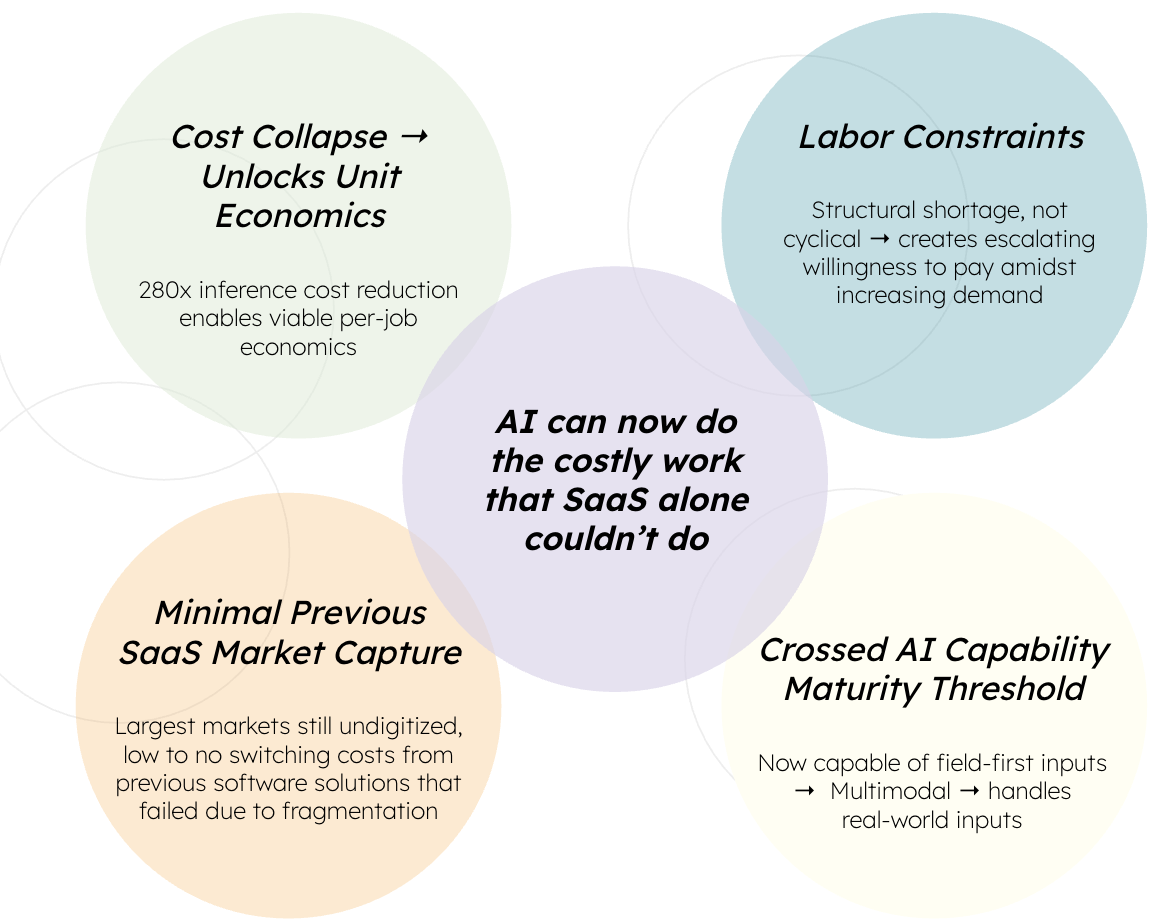
AI capability is finally field-grade. Real work runs on images, video, scans, PDFs, handwriting, and speech, which models now can interpret directly. 5
The economics now work at the unit of a job. Inference costs have collapsed (Stanford HAI cites a 280x drop for a GPT-3.5-level performance from Nov 2022 and Oct 20243), making it viable to price AI into work orders where even a few cents can buy high-value outcomes.
Meanwhile, the value pools are massive and still under software’d. Construction remains one of the least digitized sectors1, and home services and remodeling is structurally fragmented -about two-thirds of remodelers are self‑employed individuals or partnerships with no employees6 - making traditional SaaS adoption hard and leaving whitespace for execution-layer products.
Labor scarcity is also becoming structural, not cyclical. ABC estimates 349k net net construction workers needed this year and 456k next year.7 BLS projects 8% employment growth for HVAC.8 That increases willingness to pay for tools that reduce cognitive load and compress time-to-competency, making “throughput-per-technician” the killer app.
Finally, demand is durable. JCHS estimates owner-occupied improvements and repairs rose from $328B in 2019 to $510B in 2023, partially driven by higher rates keeping homeowners in place and shifting spend to upgrades, meaning there’s plenty of work to be done even in a choppy macro.6
At the same time, venture has consistently under-allocated to the sectors doing the work: construction is responsible for over one eighth of the global GDP, but construction tech drew only 3% of VC/PE capital from 2020-2022.9
That mismatch is the opportunity. When the underlying market is enormous but the digitization is thin, value accrues to whoever can own the execution decision points. Field-grade AI makes that layer finally buildable.
Section II: Where AI Sits in the Job
Where AI touches the job
The following market map prioritizes US-based, early-stage, US-based startups who are building AI solutions in the blue collar AI space.
Many companies span more than one vertical, but each is mapped by its primary work stage flow application wedge.
Startup Ecosystem Map – Technology Stack by Workflow Stage
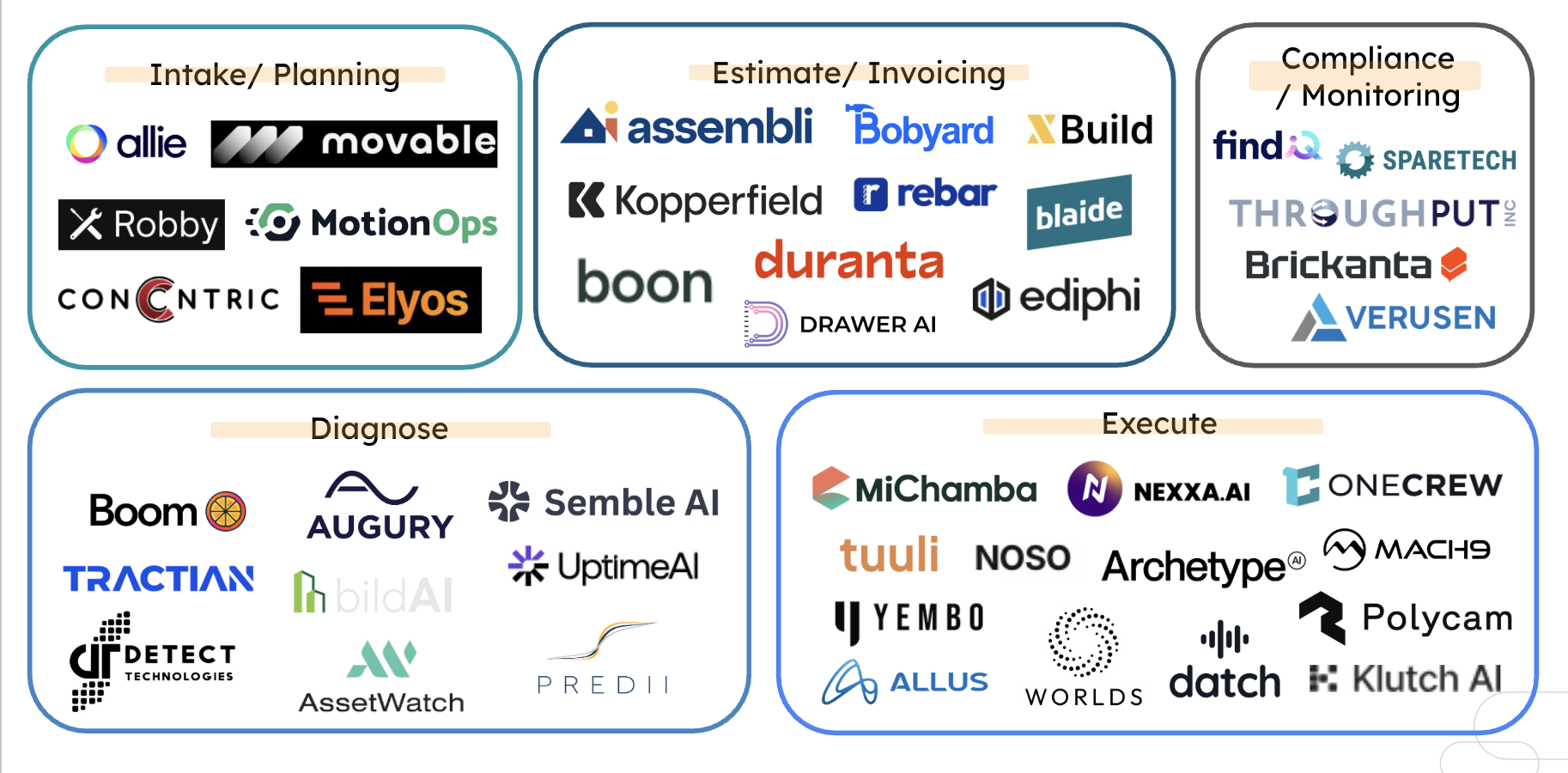
The workflow-stage framing matters because the most important shift in blue-collar AI is not just which industries are adopting software, but where in the job the software is tackling. Historically, most vertical software sat around the work: CRMs, scheduling systems, invoicing tools, dispatch layers, or reporting dashboards. These are often in the intake/planning and some estimate/invoicing stages in a typical field service workflow.
As AI continues to mature and take hold in the later stages of the workflow, there are more opportunities for startups to do things such as capture customer symptoms through voice or text and automatically route technicians based on equipment history and urgency; analyze photos, sensor readings, or maintenance logs to identify likely root causes before a technician arrives onsite; or provide visual overlays for embedded operational intelligence, to name a few burgeoning concepts.
Additionally, the following map evaluates the same companies along two dimensions: where innovation sits in the workflow, from coordination to service execution, and how efficiently they access and scale demand, from linear, fragmented sales to embedded, leveraged distribution.
Startup Ecosystem Map – Business Models for Value Creation
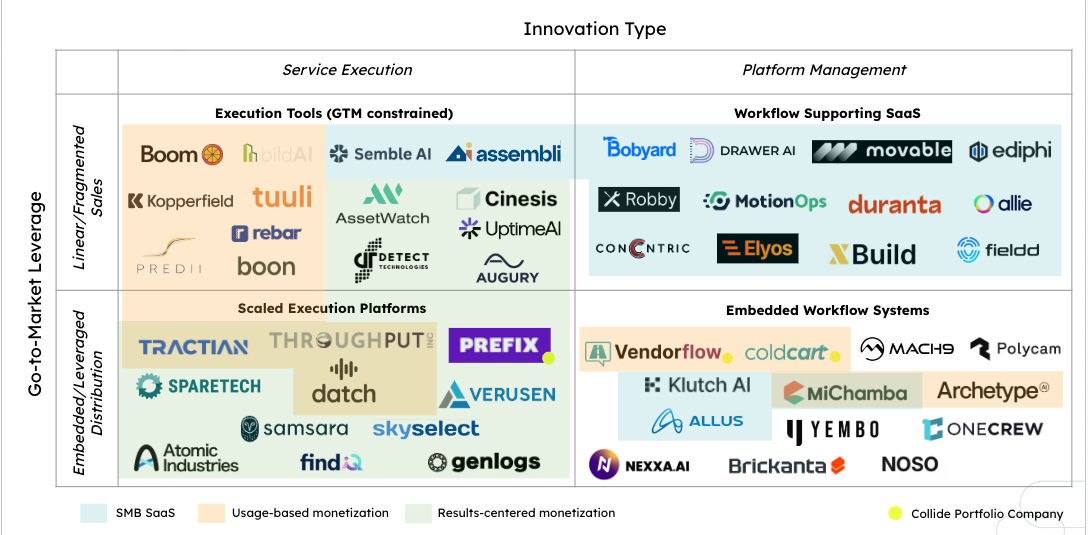
These overlays represent different dimensions of company design: go-to-market (who and how a product is sold), pricing model (how revenue is generated), and value capture (where economic control sits within the workflow). The most valuable companies combine execution-layer control with scalable distribution and value-aligned pricing.
In the top-right corner, the workflow supporting SaaS is where much of the ecosystem is still currently represented - tools supporting the workflow through individual distribution channels. This may help these products distribute and commercialize easily but may become tougher to defend over time.
The bottom-right reflects incumbent platforms with strong distribution but primarily workflow-level innovation, creating risk of feature bundling, and the top-right includes coordination tools with fragmented sales that are possibly susceptible to commoditization. Distribution isn’t just about better sales - in a world of AI commoditization, solid distribution creates its own pull by establishing undeniable revenue growth, cost reductions, or improved output.
In the top-left companies that control execution but may face go-to-market constraints that amy cause obstacles to growth, with distribution but limited execution control which may capture less value and are vulnerable to bundling. As a result, value concentrates in companies that can both influence job-level decisions and efficiently reach fragmented demand.
Companies in the bottom-left combine execution-layer products with scalable distribution and are best positioned to capture outcomes and drive venture-scale returns. These companies are not only embedded directly into operational workflows, but increasingly benefit from leveraged distribution, recurring operational data, and tighter integration into the economics of the work itself. Over time, many execution-layer companies may naturally migrate toward this quadrant as they expand distribution through platforms, OEMs, insurers, distributors, or ecosystem partnerships rather than relying solely on fragmented bottom-up sales motions.
The bottom-left quadrant also reflects where software begins to behave less like a standalone tool and more like operational infrastructure. As execution-layer platforms scale, they may also accumulate proprietary operational datasets that further reinforce their technological advantage over time, creating positive feedback loops between deployment scale, workflow embedding, and model performance, best positioning themselves as the long-term winners.
Many of these companies access distribution through existing industry channels rather than building it from scratch. OEMs, distributors, insurers, platforms, and PE-backed roll-ups already aggregate demand and can serve as natural entry points. As a result, the most effective companies pair execution control with a clear path into these ecosystems, rather than relying purely on bottom-up adoption.
Additionally, across these quadrants, business model execution varies in form factor:
- (blue) SMB SaaS businesses rely on fragmented, sales-led distribution and subscription pricing. While they can achieve early adoption, they often face higher acquisition costs, weaker retention, and increased risk of commoditization over time.
- (orange) Usage-based companies price based on units of work or outcomes rather than seats, aligning monetization with customer value for more scalable revenue expansion.
- (green) Result-anchored monetization emerges when systems control enough of the execution layer to price directly against job-level outcomes such as revenue per job, throughput, or downtime reduction. These companies move beyond selling software access and instead capture value as a function of the results they enable.
The overlays are not a strict taxonomy, but a lens on where these companies’ value is accruing based on business model trends. Companies that move beyond workflow SaaS into usage-based or results-centered models, particularly when tied to execution, are consistently better positioned to capture economic value.
Technology segmentation mapped to the matrix
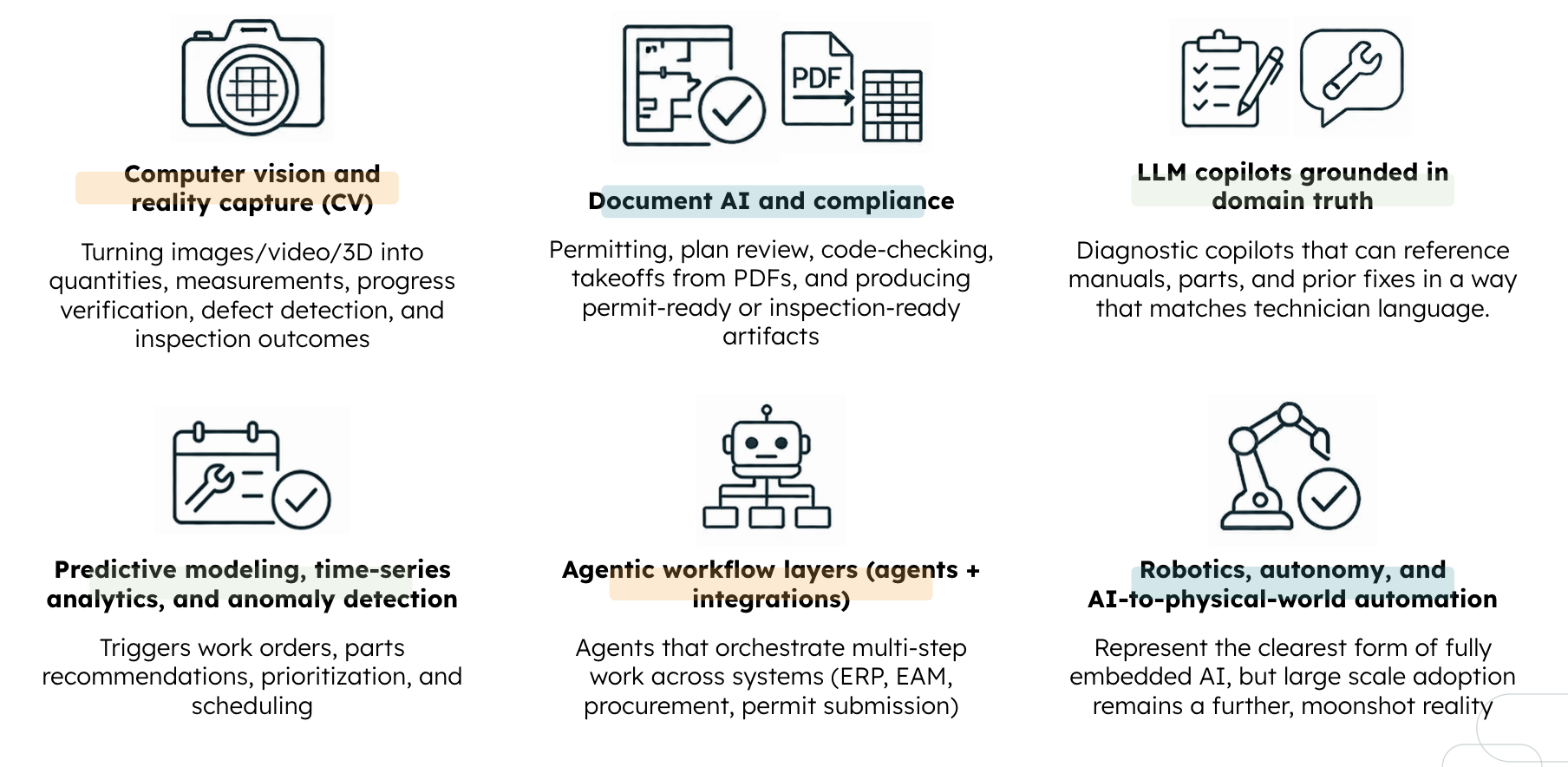
Players in this space benefit from mixing and matching from a large set of technical substrates that map differently to product vs process innovation.
Below are some common examples of technology solutions that are often found in these blue collar software players:
Market sizing of sector gaps
The clearest way to understand the opportunity in blue-collar AI is through the gap between where value is created and where software captures value today.
Service industries like home services, construction, and field operations represent hundreds of billions in annual spend, yet the software layer that supports them remains relatively small and concentrated in workflow management. In many cases, software as we’ve historically own it struggled to penetrate these environments because the work itself was too physical, variable, analog, or dependent on technician judgment for traditional systems to meaningfully participate in execution.
The mismatch is not just a function of under-digitization, but of where software has previously been only able to tackle - around the job rather than inside it.
The table below anchors this gap across key sectors, highlighting how large underlying service markets remain only lightly monetized by software:
Core framework - Value accrues at the point of execution
Distinguishing product and process innovation
Across industries, technology tends to create value in one of two ways: product innovation or process innovation.
Product innovation expands what a business is capable of doing. It enables new outputs, improves the quality or reliability of those outputs, or unlocks entirely new categories of work. These systems typically drive revenue expansion by increasing what can be sold or improving how it is delivered. More often than not, product innovation can impact top-line growth, producing more and/or better throughput that represents unlimited growth.
Process innovation, by contrast, improves how a business operates. It makes existing workflows more efficient through better coordination, automation, or visibility. These systems primarily drive cost reduction and backend utilization improvements, often impacting bottom-line costs thanks to its more incremental efficiency gains within an existing operating model.
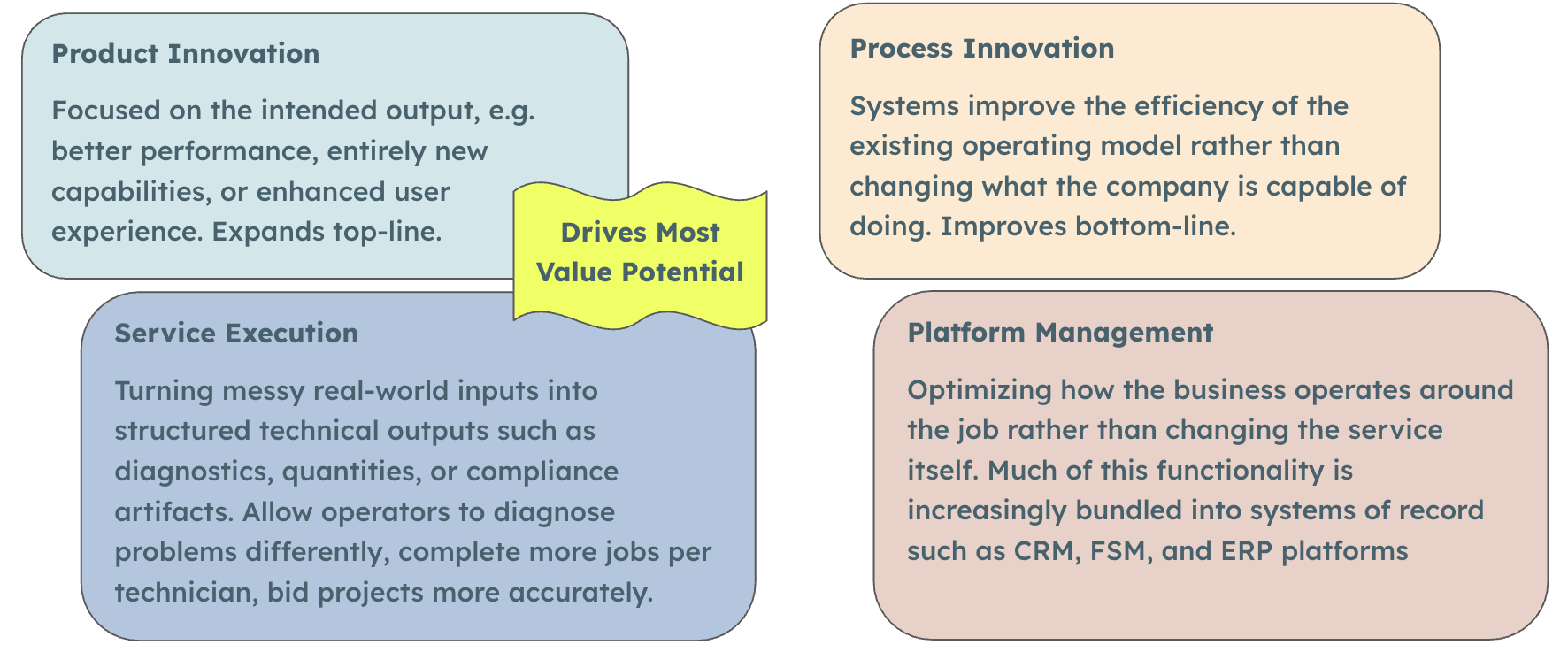
Ideally, both forms of innovation are visible and valuable. But it is true product innovation that has the unlimited upside potential for venture-sized success.
Mapping this framework to blue-collar work
In blue-collar industries, this distinction maps cleanly to where software sits relative to the job itself. Service execution represents product innovation - it’s where economic control shifts. These systems do not just participate in the work - they determine the decisions that drive revenue, cost, and risk at the job level. These systems participate directly in performing the work, e.g. diagnosing issues, generating estimates, producing compliance artifacts, verifying progress, or triggering actions.
Platform management represents process innovation. These systems coordinate work around the job - scheduling, dispatch, CRM, billing, and reporting. They improve efficiency and utilization but generally do not change the underlying service being delivered. This mapping is important because it clarifies where value accrues. In blue-collar work, the most consequential decisions are made inside the job: what is wrong, what to do, what to charge, and whether the work is complete. Systems that operate at this layer influence revenue, cost, and risk directly. Systems that sit adjacent to it primarily optimize workflow. For example:
- Skilled trades / field services → diagnosis, estimation, and repair decisions drive job margin and throughput
- Construction / property technology → takeoffs, planning, and progress tracking determine cost, schedule, and compliance
- MRO (maintenance, repair, operations) → signals must convert into actions that affect uptime and asset performance
- Cargo / transportation infrastructure → operational decisions drive throughput, routing efficiency, and cost
Why service execution wins the profit pool
Despite the recent surge of attention driven by the new world of AI commoditization, service execution embeddedness will likely become a primary moat. In blue-collar, the highest-value unit economics concentrate around: (1) improving the job, (2) risk and compliance, and (3) asset uptime. This creates three compounding advantages:
- Outcome pricing reduces adoption friction. A contractor who resists “new software” will still buy “more booked jobs,” “faster permitting,” or “fewer callbacks.” That builder-level or contractor-level willingness is increasingly visible even in platform management markets, where suites ship AI call handling to capture more demand.
- Execution systems create proprietary datasets. A scheduling suite can learn operations patterns, but an execution system can learn technical truth: which symptom maps to which fix, which photo indicates which defect, which inspection finding predicts failure. The moment the product becomes the system of record for “what actually happened in the field,” it begins to accumulate a closed-loop dataset that links inputs, decisions, and outcomes. This is meaningfully harder to replicate than workflow data, because it requires both access to execution and repeated validation over time.
- Execution wedges expand into platforms, and the reverse is way harder. Incumbents can ship AI features, but they rarely control the data loops that determine outcomes. That’s why they end up buying “execution”.
Winning models will sell outcomes more than tools
The dominant winners in skilled trades and field services are likely to converge on outcome-based promises, delivered through one of three product forms:
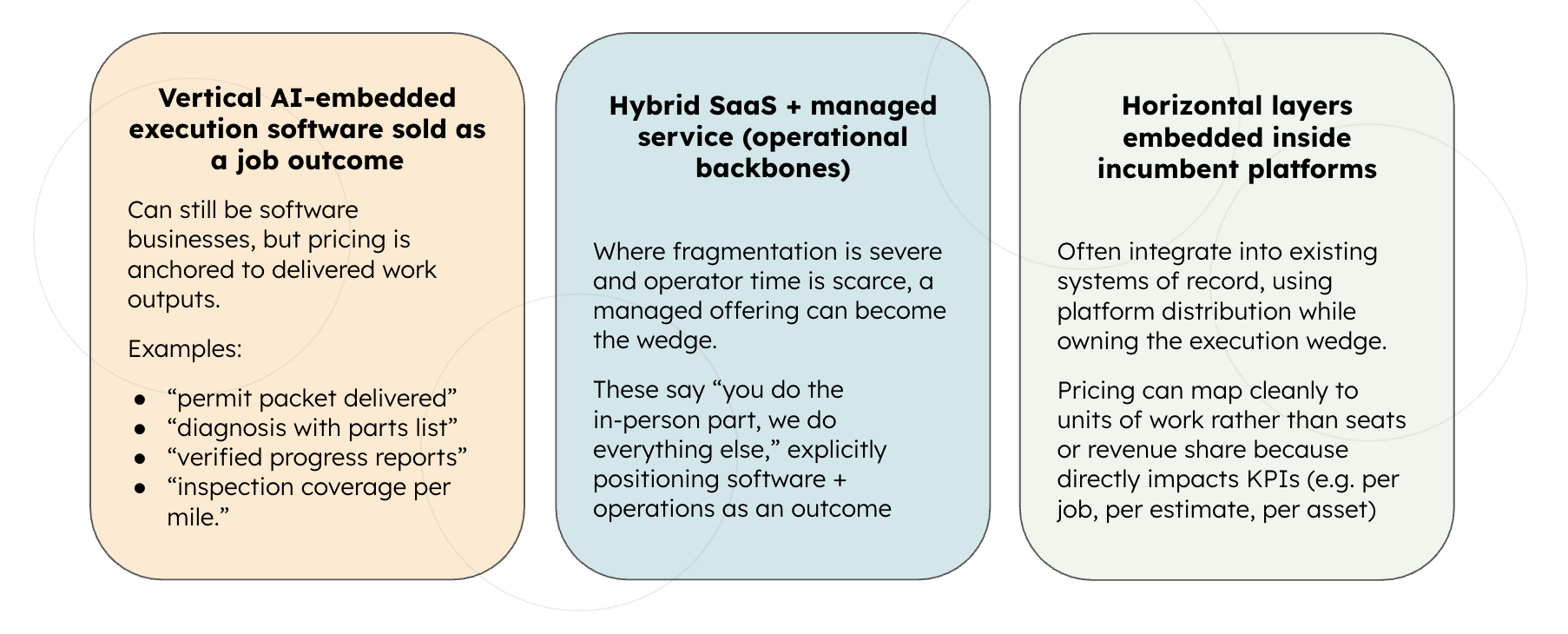
While the general discourse on the SaaS-pocalypse is an overdramatization, it is true that traditional SaaS pricing is misaligned with how value is created in skilled trades. Operators don’t pay for software, they pay for outcomes, and are highly sensitive to anything that compresses job-level margins.
This matters at the job level. A typical operator might complete a fixed number of jobs per day with variable pricing and frequent rework. If an embedded system improves pricing accuracy, increases first-time-fix rates, and enables even one additional job per day, the impact compounds quickly across revenue, utilization, and margin. This is what makes outcome-aligned pricing viable - the product is not just supporting the workflow, it is directly expanding throughput and job-level economics.
Many of the most critical economic decisions in these businesses are made at the level of individual jobs, not at the level of ongoing software access. As a result, what SaaS models get wrong is that they struggle to capture the full value they create.
At the same time, fully outcome-based models such as taking a percentage of job revenue or margin are difficult to implement in practice. Operators are highly sensitive to anything that feels like a direct tax on revenue, and attribution is often ambiguous - it can be challenging to isolate how much of a pricing improvement or outcome is directly driven by the software versus technician judgment or external factors. This creates resistance both in sales and in long-term customer relationships.
The implication is that winning companies will converge on hybrid models that anchor pricing to units of work, rather than software access or pure revenue share.
Rather than charging for access or taking a direct share of revenue, the most effective approaches map pricing to metrics like per job, per estimate, or indexed to job size - allowing the provider to capture a portion of incremental value without explicitly taking margin. These models align with how operators already think about their business, while remaining easier to justify and adopt than revenue-sharing structures.
To make this more concrete, consider a typical skilled trades operator completing ~$2M in annual revenue across ~1,000 jobs (or ~$2,000 average ticket size). In a traditional workflow, estimation error, missed scope, and inefficiencies can compress margins by 5–15% per job. An AI system embedded in estimation or diagnosis that improves pricing accuracy and first-time-fix rates can conservatively increase revenue per job by ~10% and enable higher job throughput.
A 10% improvement in average job value increases annual revenue from $2.0M to ~$2.2M. If the same system enables a 10–15% increase in jobs completed per year, total revenue increases to ~$2.42–2.53M - a roughly 25% increase in overall revenue.
This creates a natural foundation for a hybrid monetization model: a lightweight SaaS fee for workflow integration, combined with usage or job-based pricing tied to these improvements. For instance, charging a static fee per job or indexing pricing to job size allows the software provider to capture a small share of incremental value while remaining highly ROI-positive for the customer. Importantly, these gains are not just top-line - they translate directly into margin expansion. The pattern is clear: the product must be opinionated about completion, and therefore the closer pricing maps to units of work and measurable outcomes, the more value these systems are able to capture
Section III: How to Invest
Taken together, these dynamics point to a clear shift in where value is created and captured. The implication is not just where innovation is happening, but how to underwrite it.
How buyers are moving towards execution
Exit pathways
Across blue-collar software markets, acquisitions are increasingly focused on execution-layer capabilities rather than workflow tooling. Buyer demand is emerging from two primary groups:
1. Strategic software and industrial buyers
Strategic buyers are moving closer to execution, prioritizing systems that produce “truth” (diagnostics, inspections, performance outcomes) over analytics or workflow features.
Incumbents across construction, industrial, and field service software are acquiring execution-layer capabilities to accelerate roadmap and deepen workflow ownership, as seen by recent precedent in the M&A market:
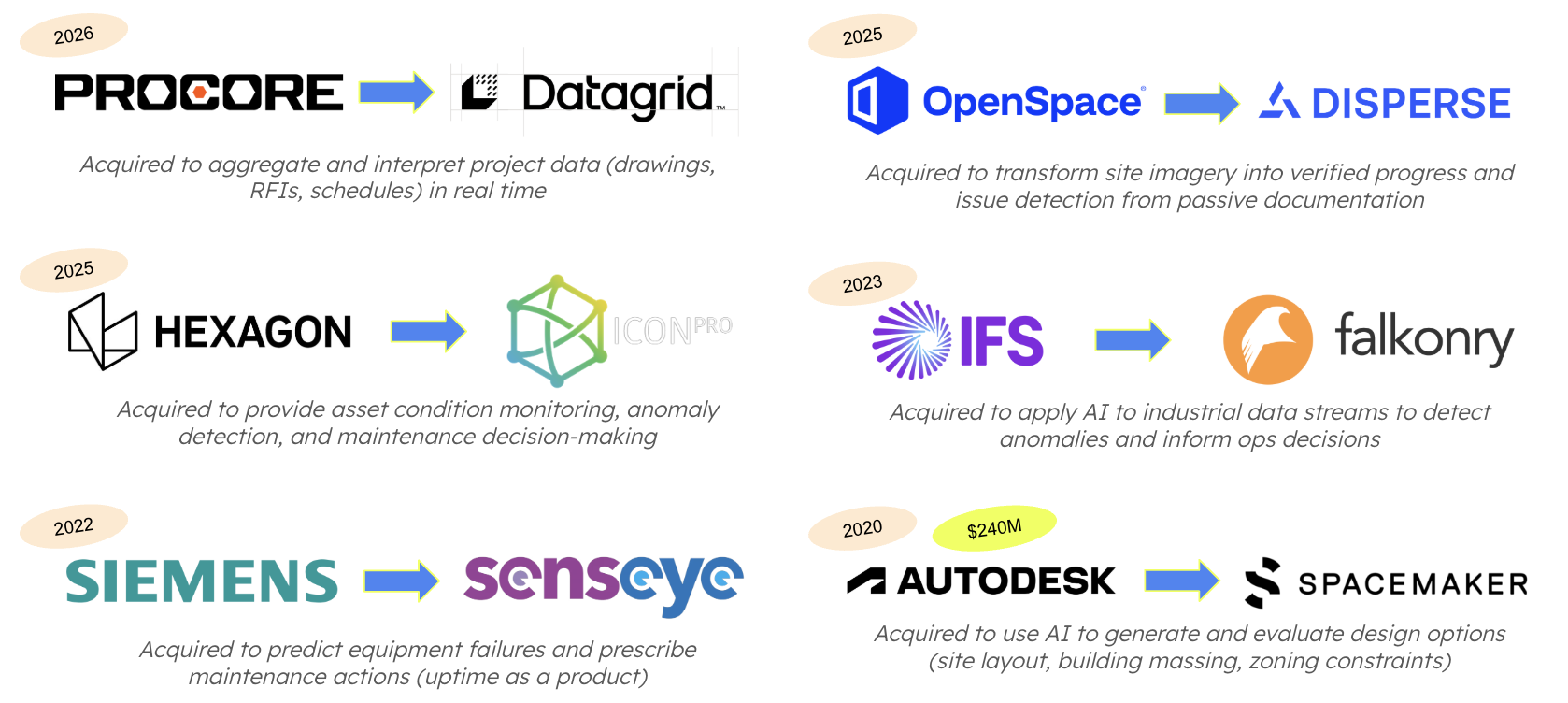
In practice, systems that control execution and generate outcome-linked data are valued less like incremental software features and more like core infrastructure, which has historically translated into stronger strategic positioning and higher-quality exit outcomes.
2. PE-backed operators and consolidators
PE-backed rollups across HVAC, plumbing, construction, and industrial maintenance are actively deploying technology as a value creation lever across fragmented portfolios.
- Tools that improve estimation accuracy, increase first-time-fix rates, reduce callbacks, or compress cycle times can be deployed across dozens or hundreds of acquired businesses
- Even modest improvements at the job level compound into meaningful margin expansion at the platform level
- In some cases, acquiring a technology layer allows operators to internalize the capability and differentiate across their entire portfolio
Execution-layer AI maps directly to PE value creation, making operators both natural customers and increasingly credible acquirers.
What wins in this market
Investment framework: how we underwrite AI in skilled trades & field services
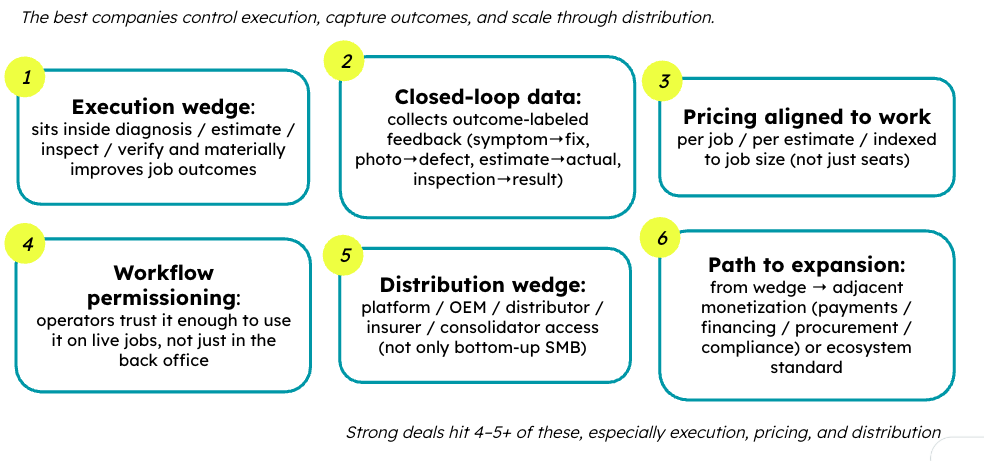
We look for execution-layer companies where AI is not an add-on. It’s the mechanism that completes a job-critical step (diagnosis, estimation, permitting, inspection, verification). The fastest way to evaluate these businesses is to ask three questions:
- Does the product touch the economic decision point?
If it doesn’t change what gets done or what gets charged, it’s unlikely to capture the profit pool.
- Does it create “technical truth” that compounds?
The best businesses produce artifacts that become the system of record: a diagnosis, a permit-ready packet, a verified progress log, an inspection/compliance output with a feedback loop from outcome → model improvement.
- Can it reach fragmented operators with leverage?
Even a great execution wedge could die if GTM is linear. We look for distribution through platforms, OEMs, distributors, insurers/warranty, or consolidators - or an outcome promise that sells itself.
Blue-collar work finally having its moment isn’t just a narrative shift - it’s an economic one. And this isn’t blue collar’s brief blip in the spotlight - this is going to be a sustained change in how the underlying foundation of modern society will finally be getting the attention they deserve.
Key takeaways:
- Execution is replacing workflow as the primary value layer
The most durable AI companies in blue-collar will not simply coordinate work - they will increasingly determine how work gets executed, priced, and verified.
- Throughout is becoming the core economic unlock
Even modest improvements in jobs completed per technician, pricing accuracy, or first-time-fix rates can compound into meaningful revenue.
- SaaS isn’t going to cut it when monetizing blue collar workThe strongest companies are increasingly aligning pricing to units of work or measurable outcomes, allowing them to capture value directly.
- Distribution matters as much as the product itself
Execution-layer products without scalable distribution struggle to reach fragmented operators, while platforms without execution control risk commoditization and bundling pressure.
- Buyers want differentiated product innovation and proprietary data
Incumbents and PE-backed operators are increasingly acquiring systems that generate proprietary execution data and directly influence operational outcomes.
APPENDIX
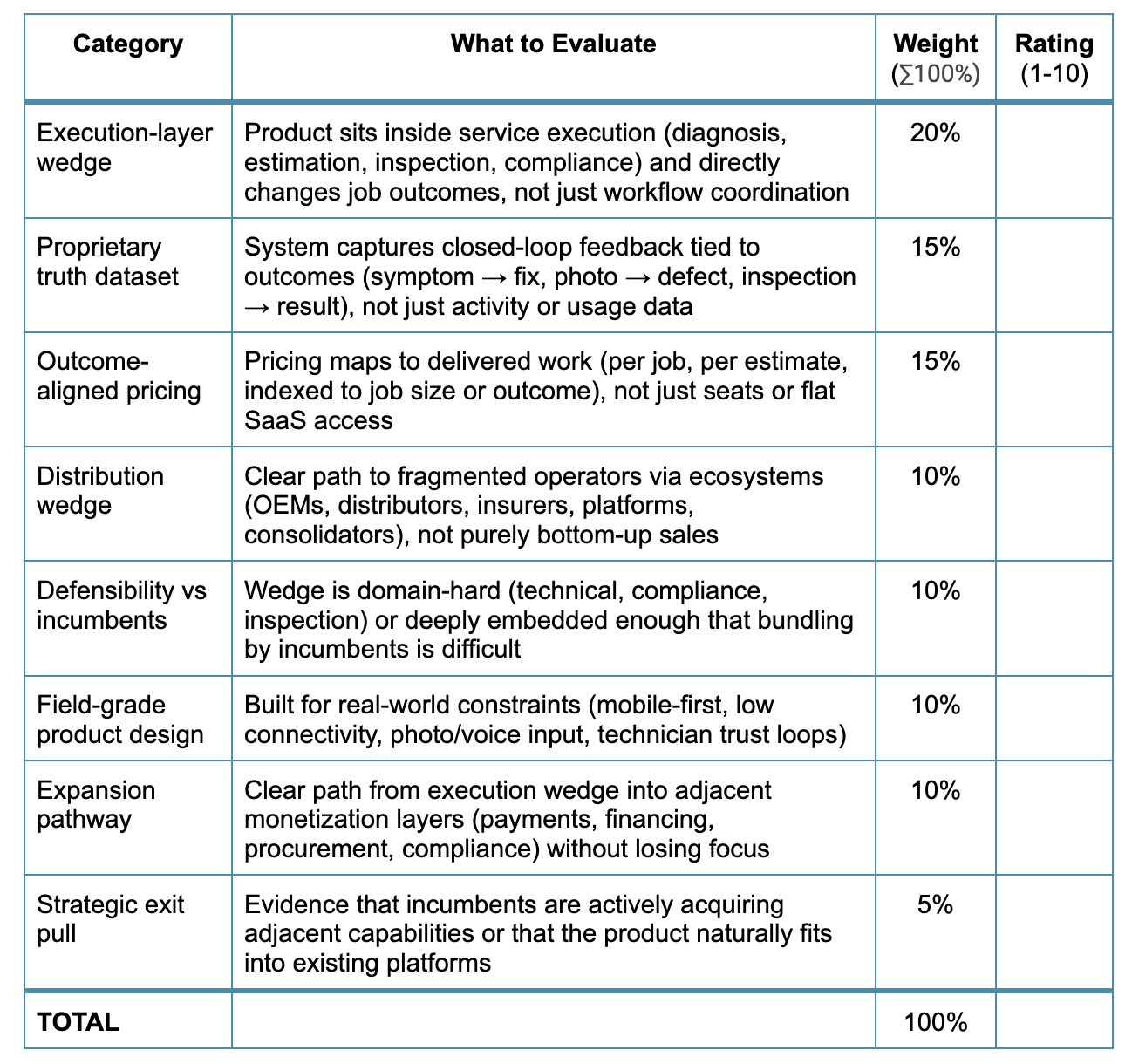
The following handy rubric summarizes what predicts category leadership in AI-embedded blue-collar companies based on our discussion on the future of this ecosystem:
Market Map Company Names
Intake
Diagnose
Sources
[1] McKinsey - Reinventing Construction Through a Productivity Revolution - https://www.mckinsey.com/capabilities/operations/our-insights/reinventing-construction-through-a-productivity-revolution
[2] Siemens Acquires Senseye - https://press.siemens.com/global/en/pressrelease/siemens-acquires-senseye-predictive-maintenance-and-asset-intelligence-industrial
[3] Stanford HAI - 2025 AI Index Report - https://hai.stanford.edu/ai-index/2025-ai-index-report
[4] IBISWorld - Field Service Management Software Market - https://www.ibisworld.com/united-states/market-size/field-service-management-software/5393/
[5] OpenAI - GPT-4o - https://openai.com/index/hello-gpt-4o/
[6] Harvard JCHS - Improving America’s Housing 2025 - https://www.jchs.harvard.edu/sites/default/files/reports/files/Harvard_JCHS_Improving_Americas_Housing_2025.pdf
[7] Associated Builders and Contractors - Labor Shortage - https://www.abc.org/News-Media/News-Releases/abc-construction-industry-must-attract-349000-workers-in-2026-despite-macroeconomic-headwinds
[8] BLS - HVAC Employment Outlook - https://www.bls.gov/ooh/installation-maintenance-and-repair/heating-air-conditioning-and-refrigeration-mechanics-and-installers.htm
[9] McKinsey - Construction Tech Growth - https://www.mckinsey.com/industries/private-capital/our-insights/from-start-up-to-scale-up-accelerating-growth-in-construction-technology
written by
.png)


